|











|
Parlement of Foules
An excerpt
In the English language, the very first mention of Valentine's Day occurs in a poem by Geoffrey Chaucer, "Parlement of Foules," written about 1380 A.D.
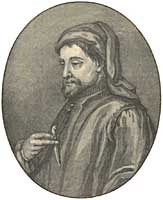 The "Parlement of Foules" is written in Middle English. The author was Geoffrey Chaucer, more widely known for his collection of stories, The Canterbury Tales. The English language has changed since the 14th Century, but we can almost understand it. With the help of a glossary, we can get the gist. The "Parlement of Foules" is written in Middle English. The author was Geoffrey Chaucer, more widely known for his collection of stories, The Canterbury Tales. The English language has changed since the 14th Century, but we can almost understand it. With the help of a glossary, we can get the gist.
Here is a passage from near the beginning of the long poem, "Parlement of Foules," by Geoffrey Chaucer.
And in a land, upon a hill of flowers,
Was set the noble goddess Nature;
Of branches were her halls and her bowers,
Wrought according to her craft and her measure;
Nor was there any bird that was ever hatched
That was not assembled there in her presence,
To receive her judgment and give her audience.
For this was on Saint Valentine's Day,
When every bird comes there to choose his mate.
Would you like to see the same lines in the original Middle English? Here they are.
And in a launde, upon an hille of floures,
Was set this noble goddesse Nature;
Of braunches were hir halles and hir boures,
Y-wrought after hir craft and hir mesure;
Ne ther nas foul that cometh of engendrure,
That they ne were prest in hir presence,
To take hir doom and yeve hir audience.
For this was on Seynt Valentynes day,
Whan every foul cometh ther to chese his make
Here is the entire text in the original Middle English, with hypertext glossary.
Article and Modern English translation of passage from the Parlement of Foules copyright 2008 by Diane Porter.
The Chaucer image is orginally from Cassell's History of England - Century Edition, and according to Wikipedia is in the public domain.
|
|
For more help choosing binoculars...

|
|