|
|

|
The Birds' ValentineBirds flashing rainbowsIn the English language, the very first mention of Valentine's Day occurs in a poem by Geoffrey Chaucer, "Parlement of Foules," written about 1380 A.D.
And it's about birds. About birds in love, to be specific. The poem is called Parlement of Foules. (When the poem was written, the word foules meant all birds.) In the poem, all the birds come before the goddess Nature to choose their mates. That's where the story begins, and even though it is a fantasy, it shows that Chaucer knew quite a lot about birds and how they choose their mates. He describes each species with a dead-on phrase. The crane is a giant with his trumpet sound. The chough (a kind of crow) is the thief. There's a scorning jay.
Chaucer also shows that he knew the birds' food habits, mentioning the heron, which is the eel's foe and the swallow, murderer of the small fly (bee) that makes honey of flowers fresh of hue. The rules of courtship The goddess Nature lays out the rules to the assemblage. The highest-ranking males of each kind get first pick of the females — but only, she emphasizes, with the consent of the chosen females. That much is surprisingly decent ornithology, according to current scientific thinking. In most bird species, the dominant males, who control good territories, have the best chance to win mates, because females will select them. In Chaucer's fantasy, three highborn male eagles vie for the same female and the other birds grow impatient as the dispute threatens to delay the proceedings. Settling the dispute, Nature decrees that the female eagle shall make her own choice, which she does. Then all the birds joyfully enfold their mates in their wings and entwine their necks. Songbirds sing praises of "summer with its soft sun and of Saint Valentine on high," and everybody flies away happy. Lovey dove I can't tell you whether to thank Chaucer, some medieval minstrel, or modern greeting card publishers for the ways we celebrate Valentine's Day today.
I was walking to the post office in my small town, as Valentine's Day is apparently not considered important enough to justify a post office holiday.
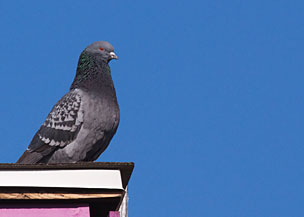
Now a rock pigeon is not a graceful walker. It sways and wobbles with each step, like a small, stiff-legged donkey with a big load. This big gray pigeon marched past all the others until it slowed in front of a slightly smaller pigeon at the far right end of the ledge. There the striding bird executed a controlled, deliberate turn. And that's what stopped me. This was not the sort of turn intended merely to change direction. It was the arching, swelling gesture of a dancer, a movement that seemed to be expressing something deeply felt. I heard a soft gurgled coo-ooh-coo.
Dance of love The bird's neck feathers rose and waved like a sea anemone ruffled by a current, doubling the neck's thickness. I noticed that those gray neck feathers were iridescent. The bird was flashing rainbows! With increasing speed, it swaggered back and forth in front of the other dove with ever more ardent turns, spreading its tail, bowing, and pirouetting. Whether in sympathy with the dancer, or because its performance aroused similar impulses in the other birds, the whole flock on the ledge began to ooh and coo, filling the street with a strange, muffled music. A living Valentine
The dove's dance was a serenade, a sonnet, a valentine. Pigeons may be commonplace, or even a nuisance, but I was on the suitor's side. I hoped the smaller gray bird would requite his feelings. Coming out of the post office a few minutes later, I saw a young man and woman in front of the theater. The young man brought a yellow rose from behind his back and presented it to the young woman. I couldn't see her face, but I she leaned and touched her forehead to his shoulder, and I could pretty well guess she was smiling. Above them, the dance of the rock pigeons continued. The birds paid no attention to the people, and it was clear the young man and woman noticed only each other. -- Diane Cooledge Porter
Painting of the rock pigeons is by Alan Messer. (See larger image.) For information on purchasing the right to use the painting, or to see more of Messer's work, please see the artist's page. The European magpie is a detail from the tapestry "The Lady and the Unicorn," which is in the Cluny Museum in Paris. The rock pigeons were carrying on in public in Fairfield, Iowa. Copyright Diane Porter 2010-2015. The Geoffrey Chaucer painting is an anonymous portrait from the 17th Century - Government Art Collection. Licensed under Public Domain via Wikimedia Commons. |
|
|










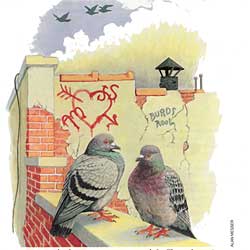 The first mention of Valentine's Day in English was over 600 years ago.
 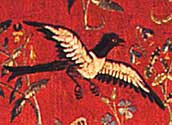 We also find a talkative pie (like the magpie, shown at right, from the Medieval tapestry, "The Lady and the Unicorn").
 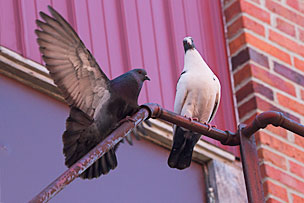 However, I can vouch for Chaucer's premise that some birds begin to choose their mates at this time of year. I have watched a rock pigeon on Valentine's Day who could have come right out of the Parlement of Foules.
  A few pigeons were loitering on the second-story window ledges of the movie theater. The day was sunny but still icy, and the pigeons were hunkered down so that their body feathers covered their feet. At the left end of the ledge, one gray pigeon got up and started walking.
.jpg) Rock pigeons can mate and nest nearly all year around in the Midwest, but their romantic pulse picks up in February. I recognized what was going on as an early sign of spring. The large dove was a male seeking the acceptance of the female of his choice. Here was a living example of Nature's rule, just as Geoffrey Chaucer described it when he wrote his poem in 1380.
Rock pigeons can mate and nest nearly all year around in the Midwest, but their romantic pulse picks up in February. I recognized what was going on as an early sign of spring. The large dove was a male seeking the acceptance of the female of his choice. Here was a living example of Nature's rule, just as Geoffrey Chaucer described it when he wrote his poem in 1380.  An earlier version of this article appeared as Diane Porter's regular column, "Backyard Notes," in the September, 2007, issue of