

| |
|
|
|
Mystery Bird of the
|
What is this bird?
I went birding at the Cluny Museum of the Middle Ages, in Paris. I found lots of birds on a series of 500-year-old tapestries known as "The Lady and the Unicorn." The tapestries include birds, animals, and ornately-dressed ladies. You can recognize some of the birds, but the bird pictured at the top puzzles me. It's shaped rather like a passerine, but no European passerine resembles it. Maybe it's exotic to Europe (since the tapestries include other fauna not native to Europe, such as lions, monkeys, and a Rose-ringed Parakeet, not to mention the unicorn). If anyone recognizes the bird, I would be most grateful to learn its true identity. Please email me.
Could this bird be a (distorted) Black Grouse? The grouse fits most of the field marks observed in the tapestry bird, except for body shape:
I imagine that earlier than the Lady and Unicorn series, which scholars judge to be from the late 15th century, someone had depicted a realistic Black Grouse in some tapestry or painting. My (perhaps hair-brained) theory is that the original picture was copied and became a familiar element of medieval art. However, the later artists most likely had never seen a Black Grouse, and so they changed the shape to make the art bird look more like birds with which they were familiar. No doubt the details changed over time. I can imagine an artist's eye expanding the extent of white onto the chest but maintaining the strange curve of the tail.
This time the tail is straight or concealed in shadow. The underwings are completely white instead of edged dark, and bill has become yellowish. I wonder if we are seeing the evolution of an artistic image, without reference to the actual species that served as original model. If you know of earlier depictions of a bird like this, or if you know another species that the mystery bird might be, please send me a note. —Diane Porter, Fairfield, Iowa |











 Diane
is puzzled. She writes:
Diane
is puzzled. She writes: 
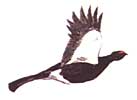 Granted,
the match is not perfect. On the Black Grouse the black extends
farther down onto the breast, and the white below is confined to
the undertail coverts. The white wing stripe may not be placed quite
right on the tapestry bird. But there is considerable similarity,
and the outward curve of the tail feathers does rather strike one.
Granted,
the match is not perfect. On the Black Grouse the black extends
farther down onto the breast, and the white below is confined to
the undertail coverts. The white wing stripe may not be placed quite
right on the tapestry bird. But there is considerable similarity,
and the outward curve of the tail feathers does rather strike one.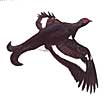 These
paintings of the actual Black Grouse come from Chris Kightley's
excellent
These
paintings of the actual Black Grouse come from Chris Kightley's
excellent 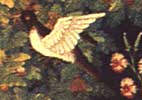 In
a slightly later tapestry, also in the Cluny Museum of the Middle
Ages, what I suspect is the same bird turns up again. This bird
is from the series "La Vie Seigneurial (Manoral Life),"
created in the early 16th century.
In
a slightly later tapestry, also in the Cluny Museum of the Middle
Ages, what I suspect is the same bird turns up again. This bird
is from the series "La Vie Seigneurial (Manoral Life),"
created in the early 16th century.