| |
|
|
|
ERGONOMICS - Dioptersfrom Midpriced Binoculars Round Upby Michael and Diane Porter We evaluated 56 mid-priced binoculars for Bird Watcher's Digest in the summer of 2007. Here continue our findings on the ergonomic qualities of the binoculars in the study.
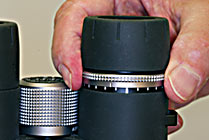
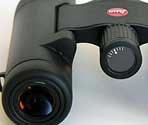
When you acquire a new binocular, you immediately set the diopter adjustment for your own eyes. If the setting holds, and no one goes and changes it, you can forget about it. If you share your binocular with others, each user needs to set the diopter personally, each time the binocular changes hands. The correct diopter adjustment is essential to a focused image. Even though a birder with non-shared use of a binocular might need to use the diopter adjustment only once, or only rarely, it's important to be able to set it easily. You should be able to turn the diopter knob without straining your fingers or scrinching up your eye with the effort. Ideally, a diopter adjustment should lock, so that it can't be accidentally moved from its setting. It should have markings or detents to facilitate putting it back to its normal setting if it does get changed. And the setting should be easy to read, so that you can confirm at a glance that it's still adjusted correctly.
We found considerable range in diopter adjustment style and quality among our mid-priced binoculars. We found lockable diopter adjustments superior to diopters that hold their setting merely by friction, but only 13 of 56 the mid-priced binoculars in our study offer the locking feature. Those binoculars with lockable diopter adjustments employ a variety of ingenious devices.
More about ERGONOMICS:
Text and photos copyright 2007 by Michael and Diane Porter.
|
|
|
|
|










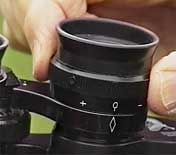 The diopter adjustment mechanism is a focus knob that lets you focus one side of the binocular separately from the other, in order to set the binocular to accommodate differences in the focusing of your two eyes.