

Purple Martins
How it all began
Purple Martins used to nest in trees. But they've been using houses provided by people for hundreds or even thousands of years. Native Americans began a tradition that we're still enjoying.
Landlord of the birds
Purple Martins love people. In fact, they can hardly live without us. At least in eastern North Amerian, they almost always nest in special birdhouses that people put up for them. These people are Purple Martin landlords.
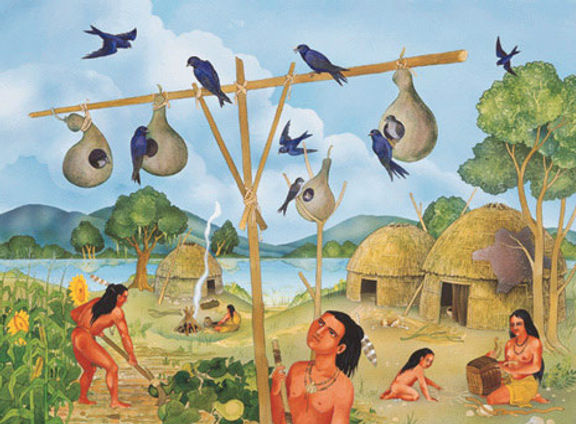
Long ago, Purple Martins nested in hollow trees, with no help from people. And then they completely changed their habits. Ornithologists guess that somewhere, sometime, a few centuries ago or more, a Native American hung up a hollow gourd at the top of a pole, and a pair of Purple Martins raised a family in it.
Maybe the birds' happy-sounding, gurgling songs appealed to the person. Maybe she liked how the birds caught and ate the flies that buzzed around the drying meat. And maybe they loved the birds' exhilarating speed and agility in the air. So the next spring she made sure a gourd was hanging in the same place, or maybe she put up two or three.
Soon a small colony of birds was gliding around the village, gobbling flies and entertaining everyone with their music. Other villagers also began hanging gourds near their homes to attract the beautiful birds. They found the Purple Martins fun to watch, and they appreciated the insect control.
Bird's-eye point of view
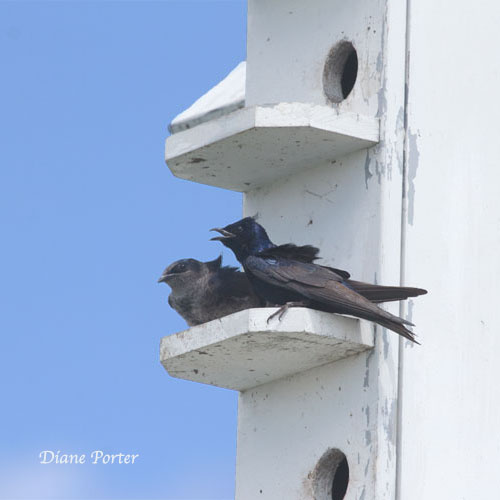
From the Purple Martins' point of view, the village commotion gave them some protection from owls and snakes, which will eat baby Purple Martins if they get the chance.
Other tribes of Native American copied the practice. Early reports say that the Choctaw and Chickasaw tribes mounted gourds on the branches of bare saplings to attract Purple Martins.
When the first European settlers arrived and learned about the friendly birds, they built birdhouses for them also, and North Americans have been hosting Purple Martins ever since. Nationwide a million hobbyists now maintain martin houses, keeping alive an ancient tradition of cooperation between bird and man.
Best shape for a Purple Martin nest
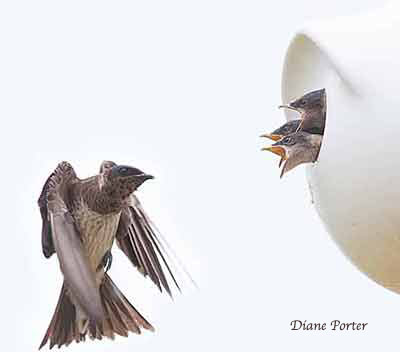
Martin houses come in many shapes and sizes. A breakthrough in martin housing is man-made gourds. This man-made housing emulates the best characteristics of natural gourds. But it's easy to clean out. The chamber is much larger than most birdhouse gourds. And it's been giving high nesting success. (It's what we now use at Birdwatching Dot Com.)
It's remarkable how completely the birds have accepted the hospitality of human landlords. Other birds, such as wrens and bluebirds, also use birdhouses, but they continue to nest in the traditional ways as well.
Purple Martins in eastern US, however, have undergone a total tradition shift. They nest only in human-provided housing, and they insist on being within about 30 to 100 feet of human habitation. They trustingly raise their young in our backyards and towns, sometimes right in the middle of our business districts.
See an assortment of Purple Martin housing you can install here.
And let your colony look convincing, too!
You may not be fooling the Purple Martins into thinking that live birds are inhabiting your colony, but a couple of purple martin decoys sure do get their attention. Purple Martin Decoy is plastic and practically indestructible. Mine have held up to five years of being outside, and they look as good as new. It's kind of cheery having them up on the houses during the winter, when the Purple Martins are gone. Several people have asked me what kind of birds those were.
See Purple Martin Decoy in the Store
Attract Purple Martins with their own Songs!
Purple Martins are attracted to the songs of other Purple Martins. Here are two CDs that will help give the impression that your birdhouses already host a thriving colony. And that may bring the start of your new colony.
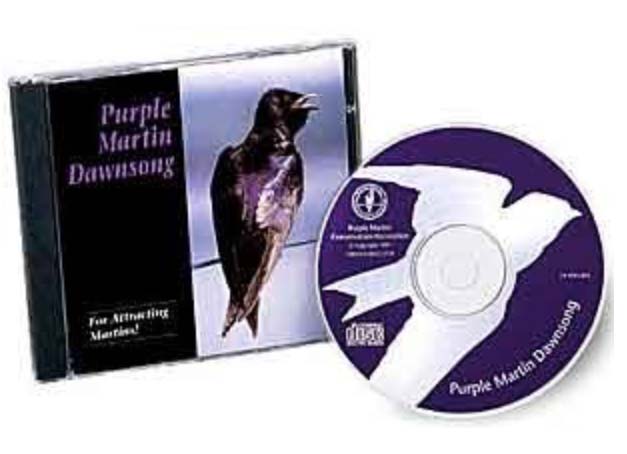
Playing Purple Martin Dawnsong is a way to get a young purple martin's attention. Play the distinctive dawnsong of the adult males near your martine housing at 3 or 4 A.M. The young males flying high overhead in predawn darkness hear the songs and come down to investigate. Then if they like what they find, they may stay and found your purple martin colony.
Some people play another CD during the day. It's the Daytime Chatter CD, and it sounds like a busy purple martin colony. I was amazed when I first played this song. Before that, I had never seen Purple Martins at my gourds. When I put on the martin songs, young Purple Martins were there within an hour, sitting on top of the housing and joining in with their own songs.