Goldenrod Bonus
How goldenrod helps downy woodpeckers
The native wildflowers of each region are plants that have adapted through the centuries to the climate, birds, and insects of the places they make their homes.
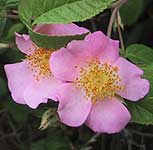
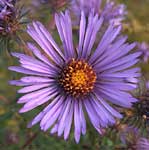
Each flowering plant provides something special to birds or other wildlife. Many provide ripened seeds after the flowers are spent, like the goldenrods and asters in the photo above.
But some wildflowers do more than offer seeds. For example, the bright yellow goldenrods also provide a rich winter bonus of fat and protein to downy woodpeckers. It's a story that begins in spring and takes many months to develop.
The goldenrod gall fly
 An tiny fly, named the goldenrod gall fly, lays an egg inside the stem of the goldenrod. In spring, when the goldenrod plants are young and soft, the female goldenrod gall fly pokes her oviduct into the stem of a goldenrod. An egg comes through the oviduct and lodges inside of the the stem. An tiny fly, named the goldenrod gall fly, lays an egg inside the stem of the goldenrod. In spring, when the goldenrod plants are young and soft, the female goldenrod gall fly pokes her oviduct into the stem of a goldenrod. An egg comes through the oviduct and lodges inside of the the stem.
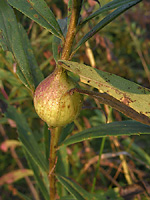 The egg hatches, about a week and a half after being laid, and now the goldenrod stem contains a larva, which is white and soft bodied. As the larva begins to chew at the inside of the stem, the plant reacts by swelling up and making a spherical gall, about the size of a large marble. The egg hatches, about a week and a half after being laid, and now the goldenrod stem contains a larva, which is white and soft bodied. As the larva begins to chew at the inside of the stem, the plant reacts by swelling up and making a spherical gall, about the size of a large marble.
The larva lives in the gall through the entire summer, eating away at the inside of the gall and growing larger. Lavae are good at chewing, and in fall the larva chews an tiny escape tunnel. But it doesn't leave the gall yet. It plugs up the hole and stays right in the gall all winter.
In spring, the inhabitant of the gall has metamorphosed and is now an adult goldenrod gall fly. An adult goldenrod gall fly does not eat, and it could not chew its way out of the the gall. But it crawls out through the hole it made for itself as a larva. And then it repeats the cycle — unless a downy spots that gall.
Bonus for a downy woodpecker
 Goldenrod gall fly larvae are full of fat, protein, and calories—the very stuff that that birds need to survive a freezing winter. Somehow, downy woodpeckers know that there is something good to eat inside those goldenrod galls. Goldenrod gall fly larvae are full of fat, protein, and calories—the very stuff that that birds need to survive a freezing winter. Somehow, downy woodpeckers know that there is something good to eat inside those goldenrod galls.
And if a downy woodpecker finds gall during the winter, it will peck a hole through the wall of the gall. This hole is big enough for the woodpecker to insert its bill. It spears the fat, juicy, larva and pulls it out of the gall. A marvelous snack for a small woodpecker on a snowy afternoon.
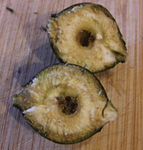 Here's what the goldenrod gall looks like inside, with a cavity in the center, where the larva was. Here's what the goldenrod gall looks like inside, with a cavity in the center, where the larva was.
That is the story of how the goldenrod provides for the downy woodpecker and helps it survive the long, cold winter. It's a good reason to let goldenrods grow wherever they spring up — and a reason to not to mow them down after they've bloomed.
For that matter, even in a garden, it's a great help to wild birds to leave the remains of flowers for the birds in winter. Those spent flower heads provide seeds that the birds want and need.
A perfectly neat garden may be a good thing, but a garden that attracts wild birds through the cold days of winter is even better.
 This story first is a Birdwatching Dot Com original. This story first is a Birdwatching Dot Com original.
Copyright 2007 by Diane Porter
Pictures copyright 2002-2007 Michael and Diane Porter
|












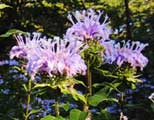 Beebalm
 Black-eyed Susan