| |
|

|
Birding by Boaton America's inland streams
Except for our little boat and its contents, we saw nothing made by man. We heard only the sounds of nature--water, creaking of trees, bird song. This could be centuries in the past, I thought. We could be in a distant jungle, or a place no human has ever visited.
Our ribbon of wilderness teemed with life. Minute insects skipped on the surface, dimpling the water, and iridescent blue damselflies landed, paired in tandem, on our knees. Fish jumped in the quieter water by the shores. On a sandy beach, two beavers nuzzled each other's faces, an adult, with its broad flat tail, and a baby only half its size. They swam across the river in front of us as we approached. Farther on, we watched a tiny, spotted fawn race along the wooded bank, going out of its way to jump over low bushes. As we passed, it leapt, twisting in the air, and landed facing the direction it had come from.
The electric trolling motor propelled us silently and barely faster than the current. That small speed advantage allowed whichever of us was steering to skirt protruding snags of trees swept into the river by past floods. Riding on the current, at the pace of the river, I felt wrapped in stillness, as if we were not moving at all. Yet the scene changed each moment. Suddenly cedar waxwings swirled around us, filling the air with high-pitched, vibratory chirps and thin whistles. Catching insects in midair, they spread their tails, showing the bright yellow band across the tip. To my delight, the waxwings skimmed near us, treating us with no more aversion than they would have shown a floating log. It was the closet look I'd ever had at waxwings in flight. For a timeless moment we glided through the waxwings, and then we left them behind.
As the sun grew hot we slid along close to a bank, where trees leaned over and shaded the water. Someone else appreciated those shadows. A double-crested cormorant swam parallel to our boat, going the easy way downstream. Swimming with its entire body underwater, only its head and long neck showing, it looked like a black snake standing upright on its tail. After a while the snaky bird's back emerged, like a surfacing submarine, the size of a small goose. Next moment it dived, and when it came up again it was far behind us, remaining in the shade. Even in southeastern Iowa, where the land is almost entirely subject to human intention, to row crops, to straight roads every country mile, the river runs its own way and sings its own song. The river can never be completely tamed. It is still dangerous, with snags that can cause a boat to capsize, and there are no street signs, no orange traffic cones to guide the traveler. The river is always full of secrets and surprises, and it changes with every rain.
I'd seen bank swallow nest holes before, but only in piles of sand in quarries. To get a close look at bank swallow nests in their primeval setting, along the steep sides of a river, one must watch them from the river itself. We steered for the edge. Along the bank the current is slow, and eddies actually flow up river, so it is not difficult to linger there. Michael used the trolling motor to keep the boat in place while I stood up on the steady johnboat and studied the nest holes at eye level.
From within the bank, a bird appeared in a tunnel's doorway barely out of arm's reach from me. It looked straight at me for a moment and then burst past and dashed out over the river. Other swallows swooped into their nest holes right in front of me. As we left to float on down the river, the swallows sailed beside us for a time, swerving to pluck insects from the air within arm's reach of the boat.
© 2007 by Diane Porter.
|
|
|










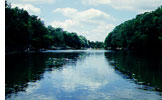 It was a perfect summer day, with white clouds lazing across a blue sky. I dangled one bare foot over the edge of the boat, and the river licked my toes with delicious coolness. I floated with my husband Michael in a sunlit corridor between two halves of a thick green forest.
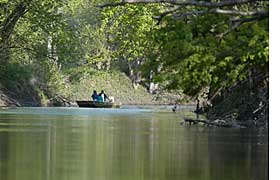 In actuality, our johnboat floated downstream in Iowa's Skunk River. Now and again we met another boat carrying a couple of fishermen to wave to, but once we pulled away from the boat ramp there was nothing to break the feeling of being immersed in the wild.
  Birders call summer the slow time of year, when expeditions may turn up few birds. That's why I was surprised on our first summer float trip to find birds everywhere along the river, with many in song as if on a spring morning. Orioles, vireos, and warblers maintained a daylong chorus, and kingfishers flew up and down the river rattling raucously. We'd found a birding bonanza hidden in the midst of Iowa farmland.
 As their calls faded into the distance, we noticed an indigo bunting's song. His loud doubled notes—Sweet sweet, chur chur, twip twip—led our eyes to a small, brilliantly blue bird partially concealed in the branches of a tall tree. As we floated on downstream, he soon handed us off to another singing indigo bunting, as that one did to the next. For the whole afternoon we were never out of earshot of indigo buntings.
 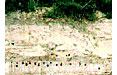 Rounding a bend, we came into a congregation of bank swallows. They swooped over the water and sailed up to a line of nest holes in the cliff, about five feet above the water.
  A band of white soil, a foot wide from top to bottom, ran horizontally along the bank. The birds had dug tunnels deep into this stratum, making a line of tidy holes, some round, some squarish, about an inch and a half wide.