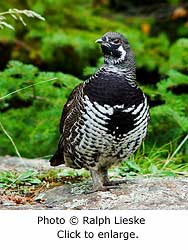
Spruce Grouse, Minnesota, February 15, 1997
 I grew up in Southern California, where frost on the grass was a novelty. For a winter treat people would take their children to the mountains to see snow. We kids would pack the white stuff onto the car's hood and bumpers and hope to get back before it all melted so we could show our friends. I grew up in Southern California, where frost on the grass was a novelty. For a winter treat people would take their children to the mountains to see snow. We kids would pack the white stuff onto the car's hood and bumpers and hope to get back before it all melted so we could show our friends.
Maybe that's the reason that even though I now live in Iowa, I still think winter is fun, and the deeper the snow, the better.
So when I got a chance to join a group of birdwatchers going to Minnesota for four days of winter birding, I joyfully met them before dawn on a frozen morning and headed toward Duluth, beside myself with anticipation about finding the wonderful birds that can be seen only in the far north during winter.
 Some snowy owls, for example, come into Minnesota in winter from the Arctic, and I longed to see one. It was on my list of possible "life birds" that I might see for the first time in my life. Some snowy owls, for example, come into Minnesota in winter from the Arctic, and I longed to see one. It was on my list of possible "life birds" that I might see for the first time in my life.
Why do birdwatchers want to see birds they've never seen before? For me, each bird is the embodiment of the place in which it lives. Encountering it, I feel as if I've met the spirit of that place and made friends with it.
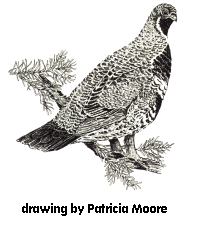
At the top of my Minnesota wish list was the spruce grouse, a chicken-like bird that lives in the remote coniferous forests of the far north. Spruce grouse pass the summer on the mossy forest floor, eating snowberries, fern tips, and the occasional spider. In winter they stay up in the trees, where they subsist entirely on the needles of spruce and other conifers.
 We had good luck in Minnesota. We found a snowy owl, perched on a tower at a power plant. The big white owl pivoted its head around toward us, looked at us through half-closed yellow eyes for 20 seconds, and then turned its gaze to something else. It was a contact. It was enough. We had good luck in Minnesota. We found a snowy owl, perched on a tower at a power plant. The big white owl pivoted its head around toward us, looked at us through half-closed yellow eyes for 20 seconds, and then turned its gaze to something else. It was a contact. It was enough.
By day three we'd found all the birds on my wish list except for the spruce grouse. For that we had to leave the motel in Duluth long before daylight and drive almost to the Canadian border.
As dawn came up, I found a new use for a credit card, shaving my frozen breath from the van windows in little slivers and ribbons of ice. Peeking out through the ephemeral clear places on the glass, I had my first glimpses of the great, silent North Woods. Spruces, firs, and other evergreens thickly engulfed us. Great looping branches draped our views, and all were loaded with snow, drenched in white. It was a frozen Forest Primeval. I felt as if I'd landed in a Nordic myth.
We'd been advised that the best time to find the grouse was before 9 A.M. It was also the only time to avoid the traffic. The forest was intensively logged, and during the day logging trucks dominated the narrow, icy roads. We hoped we would find the birds before the logging trucks were about.
These roads are an excellent place to see spruce grouse. Like many other birds, spruce grouse eat small rocks, which lodge in their gizzard and grind around with the food to break it down. After each storm, when the roads are graded and sanded, the birds come for the grit.
 We drove the roads slowly, back and forth, but to no avail. Soon the trucks came screaming down on us, shaking our van as they passed. It would seem there was no room for them to get by, but somehow they did, without ever slowing down. Life in a rifle barrel. We drove the roads slowly, back and forth, but to no avail. Soon the trucks came screaming down on us, shaking our van as they passed. It would seem there was no room for them to get by, but somehow they did, without ever slowing down. Life in a rifle barrel.
By mid morning the sun was shining at us sideways through every chink in the trees, and we were trying to get used to the idea that we might not find our grouse.
And then suddenly there was a male spruce grouse, in the middle of the road. We pulled over to the side and gawked at the bright red comb above his eye and the gleaming black breast. When everyone had seen the bird, we were about to get out and try for a closer look.
But a logging truck came from behind us and roared toward the poor grouse. "Fly away!" we all shouted, but the bird pecked at the road without concern as the truck bore down on it and concealed it from our view.
 Someone groaned, "Oh no, there goes my life spruce grouse!" We watched with helpless horror until we knew there was no chance for the bird to escape — the truck was too close, and moving too fast. Someone groaned, "Oh no, there goes my life spruce grouse!" We watched with helpless horror until we knew there was no chance for the bird to escape — the truck was too close, and moving too fast.
But in myths, impossible things happen, and somehow the bird was in the air above the truck, wings beating for the woods, tail spread in a beautiful black fan with a light band across the end like a ribbon. The field guides say this band is chestnut, but with the morning sun shining through it, I assure you, it was pure gold.
© 2006 Diane Porter
Photo of the Spruce Grouse is by Ralph Lieske, who graciously allowed us to show it here. Click the photo for a bigger picture. |