Slipping Away
There was a time when I thought there wasn't much birding to do in late summer. That was before I started trying to discern precisely when the birds left on their southward migration.
 Such a quiet morning! I'm peering into the dense understory of the woods near my house. The summer sun will rise in a few minutes, but the oriole is silent, and brown thrasher hasn't sung a note in weeks. Such a quiet morning! I'm peering into the dense understory of the woods near my house. The summer sun will rise in a few minutes, but the oriole is silent, and brown thrasher hasn't sung a note in weeks.
It's late summer. The birds are done with courtship, and defense of territory doesn't seem to be much on their minds. No more do robins face each other in forceful combat over ownership of the front lawn, and the dawn chorus of spring is only a memory.
 Some trembling leaves have got my attention, and I'm trying to see who's there. A faint, drawn-out mew comes to me, like the plea of a kitten, and then out of the brambles a gray catbird pokes its gray head, with the round black cap. Some trembling leaves have got my attention, and I'm trying to see who's there. A faint, drawn-out mew comes to me, like the plea of a kitten, and then out of the brambles a gray catbird pokes its gray head, with the round black cap.
The bird looks me over, black eye unblinking. Apparently satisfied, it withdraws, and the foliage closes over it. Until last week, I was still occasionally heard the catbird's scratchy, jumbled songs, but now all that is past.
There was a time when I considered summer a dull season for birding. It was hot out, and I didn't think I was likely to see anything out of the ordinary, so I spent less time watching birds and waited for fall to bring exciting migrants to me again.
But one day I realized that I didn't even know when the birds who nested around my house disappeared for the winter. I'd been letting them slip away unnoticed. I decided to see if I could discover when they left.
Figuring out when birds departed after the breeding season was more of a challenge than noticing when they arrived in spring, declaring themselves with song and all decked out in their most colorful plumage. At the other end of summer, there was nothing about a particular sighting to tell me this was the last time I'd see that species until next year.
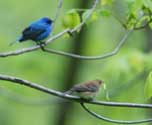 So I started carrying a notebook, small enough to fit in my jeans pocket. Every day I'd write down the birds I observed that I knew would be going south soon—catbirds, yellow warblers, indigo buntings, and other species that require a warm winter. So I started carrying a notebook, small enough to fit in my jeans pocket. Every day I'd write down the birds I observed that I knew would be going south soon—catbirds, yellow warblers, indigo buntings, and other species that require a warm winter.
My goal was simple, to discern when the birds left, but my notebook did far more than tell me the departure dates of my avian neighbors. My notebook drew me outdoors. My notebook saw things I might have overlooked. It revealed a landscape always in transition, one thing coming, another going away. It let me see beyond a single day and revealed patterns in time.
I recorded spot-breasted baby robins and the spotted fawns of white-tailed deer. My notebook saw a female yellow warbler feed a baby cowbird that was bigger than its foster mother, and then on a certain day in July there were no more yellow warblers. They were gone, on their way to their winter home, perhaps to Florida or Mexico.
In August, in a grassy field near my home, I came upon a hen turkey. Seven round young turkeys rose from beside her out of the vegetation and flew clumsily on whirring wings away from me. I wondered if it was their maiden flight.
A movement close to my feet drew my eyes to a small animal running deep in the grass. Only in the moment that it flashed across my path in a liquid motion did I get a good look at its dark brown, silky fur and tiny ears. The first mink of my life had been stalking those baby turkeys when I interrupted its hunt. How glad I was that I'd gone out that morning to see who was still around! |













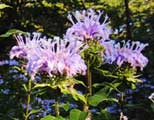 As summer lengthened, purple ironweed bloomed in the grassy field, lovely against pale lavender bee balm. Indigo buntings were among the few birds still singing their full songs by then. But any time I was outdoors I heard house wrens rattling, blue jays jeering, and cuckoos clucking.
 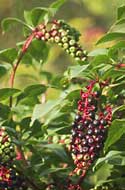 Some birds who earlier had defended their territories against others of their own species started spending time in flocks or extended families. When pokeberries ripened in a clearing and turned blue-black, a dozen catbirds sailed in from the woods to feast together amiably.
 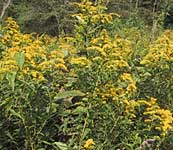 In September, goldenrods bloomed and shifted the field's color to brilliant yellow. Blue jays cached acorns in the ground. I listened with longing to the music of distant thunder and then heard the tapping of raindrops on a pond. Indigo buntings fell silent at last, and a week later they too were gone.
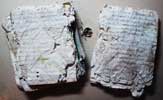 That notebook doesn't look much like a book any more. Nevertheless, its loose pages, crinkly and ragged but readable, still preserve the summer secrets of the bit of Iowa fields and woods where I find myself. This place is unique—as is every place on earth—worthy of attention, worth noticing.
  This story first appeared in the