| |
|
|
Plato among the SandpipersBut the forms which enter into and go out of nature are the likenesses of eternal realities modeled after their patterns in a wonderful and mysterious manner.—Timaeus, Plato Sometimes a bird is absolutely not in the book. Or so it may seem to a person who is trying, field guide in hand, to identify an unfamiliar bird.
All of these things, as well as shadows, stains, and feathers bent while roosting in a crowded tree cavity, can obfuscate a bird's identity. Nevertheless, birders understand that each bird belongs to a particular species (with the rather rare exception of hybrids). And even though it may be tricky to match it up to its picture, the puzzling species probably is in the book. Somehow birders learn to see past the particular, accidental, momentary aspects of the individual bird in question, to seize the pattern and recognize the species. So what is a species? Scientists have not settled on exactly what a species is, whether it depends on the shared evolutionary history of a group of birds or on their inability to breed with other species. (See "What Is a Species?") But the birder making an identification really doesn't rely on such considerations. You can't see a bird's evolutionary history, although you might make some pretty good guesses from studying its bill shape. And you can't tell by looking at a warbler whether it can mate with some other species of warbler, or whether the resulting offspring would be fertile. A birder relies instead on the innate ability of the human mind to recognize patterns. And what are those sandpipers? I had the question of species in the back of my mind one morning in late summer, as I walked along the shore of a reservoir with my binocular. I was a beginning birder, at the stage when I had a good chance of discovering a new bird any time I went out birding. This was one of my early attempts at identifying shorebirds.
I'd been studying the shorebird section of my field guide, especially the small sandpipers, called peeps. The peep pictures all looked pretty much alike to me. Even in the idealized, simplified images in the book it was hard for me to see the differences between the shape and length of their bills or between the neutral greys and browns of their feathers. In my previous attempts to puzzle out the peeps, confronted with the actual birds, I'd not been very sure of my identifications. But I was up for the challenge. I was determined to figure out what those three sandpipers were. I looked at the birds carefully and compared them to the pictures. I read all the similar-sounding descriptions. One clue I could get a grip on was that the least sandpiper was the only peep with yellow legs. I looked hard through my binocular at the birds' legs. However, leg color proved not so easy to determine on the constantly moving birds. One moment the light glared off the legs, and the next moment they were hidden in shadow. For a while I thought they were black, then deep rusty brown, and occasionally they looked dark green. The only thing I could say for sure was that the legs were not yellow, and that meant that these birds were not least sandpipers. One species eliminated. Process of elimination I sat on a big rock, the only mud-free surface, and pored over my field guide. I ruled out semipalmated sandpipers because the field guide said that species should be picking at the surface for food, not probing the way my three peeps were doing. I rejected western sandpipers because their backs weren't as rusty as the one in the picture. I discarded dunlins, because although my peeps' bills drooped slightly, I thought the droop was not pronounced enough for dunlins. One by one, I eliminated each species of small sandpiper, until none was left. There was simply nothing they could be. I re-read all the descriptions of sandpipers and restudied all the pictures in my field guide and looked some more at the three peeps. As if to taunt me with their unknowability, the birds walked between the water and me, so close that I had to turn my binocular's focus wheel all the way to the end. One bird stopped and watched me. I could see every feather. We shared a long moment of mutual study. Then it turned and stepped into the water. And when it raised its foot, I saw muddy water run off, as if in slow motion. Muddy water running off, revealing a yellow leg! With the next step, the leg was covered once again with dark mud.
A moment before, those intimations of yellow had escaped my notice. Now that I knew what I was seeing, my visual experience itself was transformed: I could see now that the legs were yellow. It was as if mind had given instruction to eyes, and the eyes saw through the surface to the actual reality. In that penetration, the species became visible. A long time ago, Plato said that for everything that exists there is an ideal pattern, or form, and that these patterns underlie all objects in the world. He said that first we know the form of a thing, be it a circle, a color, a man, or goodness, and then we perceive its likeness in the world. Today we know that species change, evolve and encompass much variation. They are not unchanging forms. But perhaps Plato's forms reflect something about the way a birder perceives and recognizes a species. It is mysterious, this matter of perception. We are not cameras, tape recorders, thermometers, though our senses serve us in some ways like these instruments. Without the mental forms to which we relate our experiences, all we perceive would be shapeless dust, and no one could tell a sandpiper from a stone. In that recognition of the least sandpiper, I saw the form beneath the changing mud, the pattern that illuminates the particular. I saw the bird itself. And walking back from the reservoir that day, I wondered what other patterns I might see, were I awake enough to see them. -- Diane Cooledge Porter Story first appeared in Bird Watcher's Digest, September, 2007. |
|
|
|











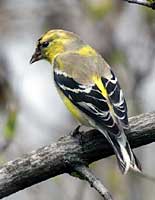 And the perplexed birder may be right. Sometimes birds don't look like their pictures. A molting American goldfinch (photo at right) displays a motley patchwork of its summer gold and winter drab colors that few field guides display or comment on. View a bright blue indigo bunting out of direct light, and it looks black. Less commonly, the bird in question might be a partial albino, with white feathers where it should have red or black ones. Or perhaps it recently lost its tail to a cat, hopelessly confusing its silhouette.