Listen to the Mockingbird
When a bird has murdered sleep
 Recently a reader
emailed me that a mockingbird sings in a tree close to his house each night
and keeps him awake. He wanted to know how to discourage this bird from
nesting near his house or from singing there at night. Recently a reader
emailed me that a mockingbird sings in a tree close to his house each night
and keeps him awake. He wanted to know how to discourage this bird from
nesting near his house or from singing there at night.
The Northern Mockingbird is a world-famous singer, considered finer even
than the Nightingale of Europe (the one John Keats wrote about in his "Ode
to a Nightingale"). The male mockingbird sings a medley of songs belonging
to other birds, repeating each phrase several times before moving on to
the next. Unlike most songbirds, which learn their songs before they're
a year old, a mockingbird continues to expand his repertoire all his life.
Some include the sounds of people whistling, frogs croaking, and doorbells
ringing.
Although all adult male mockingbirds sing during the day, only a bachelor
sings at night. He stops doing that as soon as he wins a mate. What the
person who emailed me was complaining about was a love song.
Law is on the side of love and the bird, for it is illegal to harm, harass,
or remove the mockingbird.
But what about the poor human, who must get up in the morning and go
to work? I replied to the mockingbird man and told him that the night singing
would probably cease soon. I also told him a secret about how to cope with
the "noise."
How I learned to survive night-time bird songs
I learned this secret many years ago, when my husband and I first moved
to Iowa. We went camping in the woods. At dusk, as Michael and I sat watching
our campfire, the Whip-poor-wills began to sing. Repeatedly, once every
second, they chanted their name.
Whip-poor-will!
It was charming at first, and I was pleased to discover a bird that was
new to me.
Whip-poor-will! Whip-poor-will!
The evening grew darker, the fire subsided to coals, and Michael and
I went to bed. We were ready to go to sleep. The Whip-poor-wills were not.
A Whip-poor-will easily performs 1000 renditions without a pause. They sang
on and on.
Whip-poor-will! Whip-poor-will! Whip-poor-will!
The song was beautiful, but loud, and close, and I wondered if it would
ever stop. However, it didn't seem to bother Michael. Impossible though
it seemed, he was sound asleep. I turned over. I tried re-adjusting my blanket.
I punched my pillow into various shapes. I felt as if one of the birds were
trying to find out how near to me it could get before I reached over and
grabbed it in the darkness.
It became apparent that sleep was not going to come, and eventually I
gave up trying. I lay in the darkness and watched the stars and listened
to the Whip-poor-wills. And gradually something remarkable happened: after
I stopped trying to will it away, the song began to reveal itself to me.
I noticed textures—burriness, purrs, and accents, subtle ripples
upon the larger waves of sound. The birds did seem to be singing their
name, but "Whip-poor-will" was only a crude representation of
the cadence. I discovered that the middle syllable was slightly doubled.
"Whip-poorer-will, Whip-poorer-will." The counterpoint
of several voices made shifting moiré patterns of sound.
After a while the chant began to soothe, like an ancient lullaby. Tree
frogs thrummed a steady background, and a couple of Barred Owls broke in
now and again with their baritone hooting.
It wasn't long before I began to drift, as if I were floating in the
sound, and then to doze. Once I woke while it was still night and found
that the Whip-poor-wills had fallen silent. I rather missed them. But soon
they raised their voices again and lulled me deeper into their song, and
off again to sleep.
It was years before I actually saw a Whip-poor-will. They are seldom
found in the daytime, because they have the coloration of a handful of dead
leaves, and they spend their days on the leaf-strewn forest floor, where
they are perfectly camouflaged. But ever since that night I have regarded
the Whip-poor-will as a particular favorite and personal friend.
My advice to the mockingbird's victim
If I succeeded in persuading my email correspondent to give up fighting
against its love song, he may have a similar experience with the mockingbird.
The man is interested in birds, so maybe he will detect a cardinal's greeting
embedded in the bird's melodies. Or the warble of a House Wren, like the
ones nesting in his birdhouse. Perhaps he'll recognize in this pouring music
some notes from the longing of his own heart, and his irritation will begin
to melt. It is one's irritation that keeps a person awake, not the bird.
I have found that the same principle works for other night-time voices—cicadas,
frogs, and owls. Natural sounds that are annoying when I try to escape
them become a pleasure when I simply listen to them.
It is ironic that we sometimes take such exception to the sounds of nature.
Human beings are the most relentlessly boisterous creatures on earth. We
produce noise day long and night long, most of it not nearly so melodious
as the mockingbird or the Whip-poor-will.
A few years ago, when Michael and I made a video
on birdwatching, we were amazed how difficult it was to find outdoor
sites where the microphone did not pick up trains, road noise, and lawnmowers.
A former Curator of Natural Sounds for the Cornell Laboratory of Ornithology
told me his greatest challenge when he was recording the songs of birds
in the Amazonian rain forest was not locating the birds but finding a place
where he could record them without also getting the sound of chain saws.
I hope the person who e-mailed me about the mockingbird will try my suggestion.
If he does, I think the bird's song will become dear to him. And if someday
he moves out of the mockingbird's range, he will miss it. I know I do.
 Copyright 1998 by Diane Porter Copyright 1998 by Diane Porter
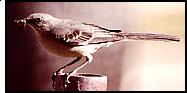
Photo of Northern Mockingbird by Michael and Diane Porter
If you want to learn to recognize bird songs, there are many excellent
resources to help you. Some tapes are encyclopedia-like collections of bird
sounds. In others, such as the Birding by Ear series, the narrator tells
you what to listen for and helps you fix the bird sounds in your mind so
that you will remember them. See Bird Song CDs.
I admit, the poem referred to at the top of this page is a bit somber.
(It was, after all, written by a man in his 20s who was dying of TB.) But
you can read
Ode to a Nightingale here if you want to see how the nightingale inspired
one of the greatest poets of the English language.
More Birding Stories by Diane
Birding Tips
Bookstore
Home
Birding FAQ
Birding Video
Birding Software
Birding Optics
Birding Store
Home
FAQ Tips
Stories Videos
Software Optics
Bookstore Orders
|