|











|
Hawk Guides
A Field Guide to Hawks
A Photographic Guide to North
American Raptors
Hawks in Flight
Below are some specialized
books devoted entirely to raptors. They will show you what all the North
American hawks look like, whether they're old or young, perched or flying,
close or distant. These books are the key to knowing the hawks.
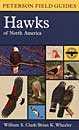 A Field Guide to
Hawks, North America, by William S. Clark and Brian K. Wheeler,
a Peterson Field Guide series book, published by Houghton Mifflin Co,
1987. Paperback, 198 pages. A Field Guide to
Hawks, North America, by William S. Clark and Brian K. Wheeler,
a Peterson Field Guide series book, published by Houghton Mifflin Co,
1987. Paperback, 198 pages.
If you were going
to get only one hawk book, this would be the one to start with. The authors
have studied the hawks of North America for years, searching for new field
marks to identify each species. In this book they share their discoveries,
providing many details that you won't find in basic field guides.
There is a whole
page or more for each species, with color paintings of males and females,
immatures and adults, of each race. For each species, two or three pages
of text explain the pictures, and a map shows where the bird lives in
summer and in winter.
If you want to start
identifying hawks, you must have this book.

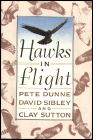 Hawks in Flight,
by Pete Dunne, David Sibley, and Clay Sutton, published by Houghton Mifflin
Co, 1988. Paperback, 254 pages, $13.00 (You can probably get it f0r
less if you order
here, through Amazon Books.) Hawks in Flight,
by Pete Dunne, David Sibley, and Clay Sutton, published by Houghton Mifflin
Co, 1988. Paperback, 254 pages, $13.00 (You can probably get it f0r
less if you order
here, through Amazon Books.)
This book teaches
you how to recognize flying hawks, even at a great distance. Lively, readable
prose lays out the nuances of flight style, such as how the hawk holds
its wings when it's gliding, and how it flaps. The Kestrel, we learn,
has a fluttery wing beat and buoyant flight, while the Merlin's strokes
are short, powerful, and piston like. Study this book, and soon you'll
amaze your friends by identifying hawks that are mere specks in the sky.
David Sibley's pen-and-ink
drawings communicate the essence of each species. Many of the pictures
are small silhouettes, the way distant flying birds appear. You see a
tiny Merlin chasing a Golden Eagle, a Mississippi Kite swooping to catch
a dragonfly, a short-tailed Black Vulture flying with long-tailed Turkey
Vultures. In each case, you're learning something about the birds' appearance,
flight, and temperament.
The authors developed
their approach through years of experience watching and censusing flying
hawks at migration sites. You can reap their experience and then have
the satisfaction of identifying hawks on your own. All text and drawings,
with no color pages, the book is remarkably inexpensive -- one of the
best book bargains you can find.
***
These are books to
savor in your spare time, and to carry in the car when on the road. And
while you're out admiring the fall foliage, the snow scapes, or the flowers
and trees, don't forget to look up at the sky. You might see the wildest
of the wild, riding the wind.
 © 2005 by Diane Porter © 2005 by Diane Porter
Home
FAQ Tips
Stories Videos
Software Optics
Bookstore Orders
|